





Fisheries body stands over its Weir salmon numbers data
Published:
-

-
Author: Dara Bradley
~ 4 minutes read
From this week's Galway City Tribune
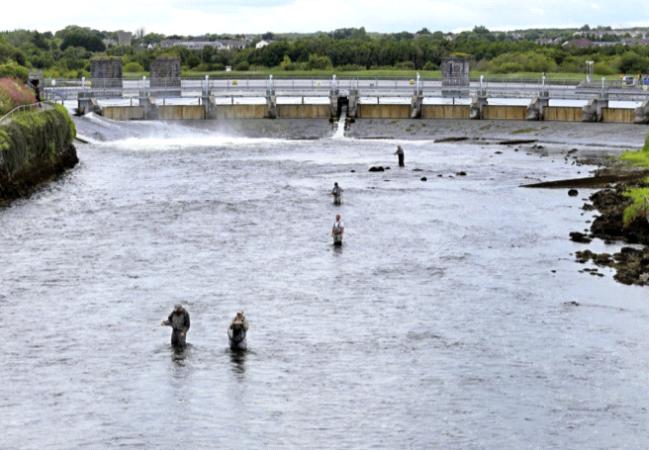

Inland Fisheries Ireland (IFI) has insisted it stands over the data it collected about wild Atlantic salmon numbers passing through Galway Weir.
It comes amid claims by local anglers about inaccurate salmon figures due to a broken counter on the Corrib for a sustained period this year.
IFI insisted the salmon numbers — used to justify a new controversial policy of ‘Catch and Release’ on the Corrib system in 2026 — for the last five years are accurate.
The organisation responsible for the country’s rivers and lakes conceded to the Tribune that its counter was broken earlier this year, but it said this was for a week, and not months as claimed by local anglers.
IFI said its Corrib counter at Galway Weir has provided accurate records between 2021 and 2025.
It said the only “unscheduled down time” of the counter was from July 2-8, 2025, to facilitate works to install a new counter.
IFI said this down time was communicated to the Technical Expert Group on Salmon (TEGOS), which provides river-specific scientific catch advice.
The counter was broken “during low and warm water conditions not conducive to fish movements” it said.
“During the period before July, the Office of Public Works had cordoned off the walkway above the tube counter as it had been condemned following a structural inspection. The works were completed in June 2025. These works did not affect the operation of the fish counter, which continued to provide counts throughout,” IFI said.
IFI said it operates two counters in the fish pass in Galway, “with the resistivity counter scheduled for removal in 2026”.
It insisted it was “satisfied that the figures used for the Corrib system are based on the best available scientific advice, and the (Catch and Release) measures proposed are necessary in light of the uncertain future trajectory of our salmon stocks”.
Billy Smyth, secretary of Galway City Salmon Angling Association, in a submission to the public consultation about the new Catch and Release policy, claimed the IFI’s salmon counts were inaccurate.
Mr Smyth claimed that the fish counter was not working for up to 12 months, and he questioned how TEGOS had settled on a figure of 7,551 salmon running through the Corrib when the data was incomplete.
IFI said the context of its new Catch and Release policy was the trajectory of wild Atlantic salmon populations on Corrib and other waters.
“From a peak of over one million migratory salmon returning to Irish waters for much of the 1970s, numbers have declined catastrophically to less than 200,000 in recent years,” it warned.
Each salmon river system in Ireland, including the Corrib, has a designated conservation limit (CL), representing the number of adult spawning salmon required to maintain a healthy and sustainable population.
For the Corrib, the CL is 7,564 which is the minimum number required to sustain the population, IFI said.
It said TEGOS used forecasting models, based on the likely abundance of migratory salmon returning to each river system each year.
The North Atlantic Salmon Conservation Organisation (NASCO) advise that stock exploitation should not solely be managed to the standard conservation limits but should also have management targets above the CL to incorporate “an additional level of precaution”.
“Stock assessment and catch advice are therefore designed to ensure a high level of certainty that the CL will be achieved. Under standard assessment procedures, catch advice is provided based on a 75% probability that forecasted returns will meet or exceed the CL at the advised quota.
“Consistent with NASCO’s precautionary approach, IFI has decided a higher level of certainty is warranted nationally for 2026 season. Accordingly, catch advice has been provided using an 85% probability that the CL will be met. At this probability level, no surplus stock is available on the Corrib system for sustainable harvest of adult salmon,” IFI said.
It said this ‘cautionary approach’ was why it was introducing a Catch and Release’ policy on Corrib and other waters in 2026.
Angling organisations across the country have criticised IFI’s new policy, and claim anglers are being scapegoated.
Pictured: The only “unscheduled down time” of the counter at the Weir was one week last July, IFI insists. PHOTO: JOE O’SHAUGHNESSY.
More like this:

Blooming reeds leave swimming area closed in Portumna
By Avril Horan CONFUSION over who is responsible for removing reeds at the Portumna swimming a...

Unauthorised encampment in shadow of Portumna Castle
By Avril Horan CONCERNS have been raised over the continued presence of an unauthorised encamp...

Calls to pull plug on Electric Skyline contract
By Avril Horan CALLS have been made to ‘pull the plug’ on the public lighting maintenance cont...

Galway City Council on the brink of deal for Pálás
Galway City Council is nearing a deal to secure the future operation of Pálás Cinema, the Galway ...

Seapoint seeks a change to its big regeneration plans
The owners of the Seapoint Leisure complex in Salthill are seeking permission to demolish another...

‘Cheap shot’ at Sinn Féin reveals testing times for Left-wing unity
Bradley Bytes – A sort of political column by Dara Bradley Eibhlín Seoighthe has confirmed tha...

Galway poet Stephen wins first Gerald Dawe bursary
Galway city poet Stephen de Búrca has been selected as the recipient of the inaugural Home Again ...
Titans set for thriller with Neptune in U-20 Cup final
It’s the biggest weekend of the basketball season with 11 cup finals down for decision in the Nat...

National Park centre hosts Connected in Connemara
Connected: Connemara, a joint exhibition from artists Siobhán Moore and Elaine Cunningham that ce...
Sign Up To get Weekly Sports UPDATES
