

Galway student uses genetics to uncover why bowel cancer resists immunotherapy to improve patient survival
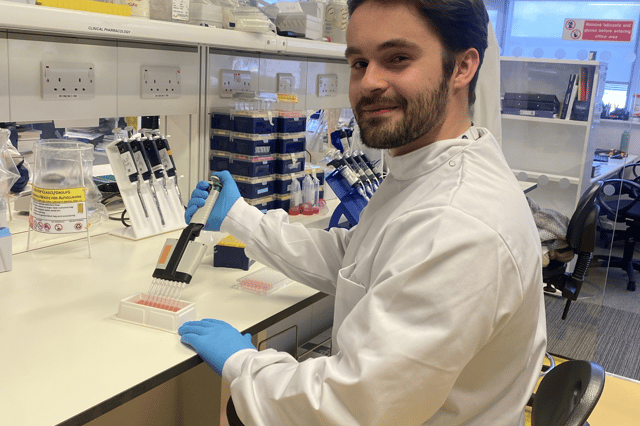

Using genetic engineering approaches, Nial O’Reilly’s research focuses on how colorectal cancer cells can use sugar molecules called sialic acids as a kind of invisibility cloak, helping them evade the immune system and making it harder for immune cells to recognise and attack them.
A Galway student is hopeful his research into why bowel cancer resists immunotherapy will help improve outcomes for patients diagnosed with one of Ireland's deadliest diseases.
Bowel cancer is the second leading cause of cancer death worldwide. Around 2,562 people each year develop bowel cancer, also known as colon, rectal or colorectal cancer in Ireland. Worryingly, rates of colorectal cancer in under-50s have almost doubled in the 25 years to 2019, with one in 10 people diagnosed aged under 50.
The Marie Keating Foundation's support group for people with late stage cancer has seen a significant increase in the number of people under 50 with a late stage colorectal cancer diagnosis signing up.
PhD researcher Nial O'Reilly has spent the last two years studying why immunotherapy has shown limited benefit for most bowel cancer patients when it has revolutionised the treatment of cancers such as melanoma and lung cancer. Immunotherapy uses the host immune system to better target cancerous tumours.
Using genetic engineering approaches which he honed studying a degree in genetics and genomics at the University of Galway, Nial’s research focuses on how colorectal cancer cells can use sugar molecules called sialic acids as a kind of invisibility cloak, helping them evade the immune system and making it harder for immune cells to recognise and attack them.
They do this by connecting with the immune cells and essentially turning them off.
“The project is about finding the genes that suppress the immune system. There are many proteins involved in producing a sialic acid, if we can target the specific proteins of interest we can remove the sialic acid invisibility cloak so that the immunity cells can do their job,” he explained from his lab at the Lambe Institute for Translational Research.
He is half-way through the four-year doctorate, which received a €140,000 grant from the charity Breakthrough Cancer Research which supports projects focused on cancers with poor outcomes.
Nial reveals that the results so far have been promising but advancing from the pre-clinical tests to the clinical stage is still a long way off.
The son of Irish parents who emigrated to France, he moved from his home in Lyons in 2020 to study genetics and genomics, which blends biology, maths and data science. Genetics is the study of DNA while genome is the full DNA code of any organism.
He was one of just a handful of students at the University to advance from a degree to a doctorate in Pharmacology and Therapeutics after his project was approved by Dr Aideen Ryan, Professor in Tumour Immunology at University of Galway, who is the project supervisor.
Niall works alongside other PhD students who have overlapping research areas in colorectal cancers.
“It's a collaborative way of working. We have weekly meetings about what we're doing, what we're struggling with, there's brainstorming to overcome stumbling blocks. We also work with senior lab members who have PhDs. Aideen is always brilliant; if I've a problem, she gives me a million different solutions.”
Aideen explained that an important breakthrough came after her research group identified a particular type of cell within tumours that can suppress the immune system.
“By uncovering how these cells influence the immune response, we hope to take an important step towards developing new treatments that can be combined with existing immunotherapies, strengthening the body’s ability to fight bowel cancer and giving patients more options in the future.
“We are extremely grateful to Breakthrough Cancer Research for funding this important work, and to the patients who generously donate samples to our research. Their support is invaluable in helping us better understand bowel cancer and bring us closer to improved treatments for patients.”
Orla Dolan, CEO of Breakthrough Cancer Research, said their goal is “to make more survivors of cancer by funding research into new, better, kinder, smarter treatments and diagnostics for people with cancer”.
“We are particularly focused on cancers where treatment options are limited, and survival rates remain low. Nial’s research is a powerful example of why this work matters. By supporting researchers like Nial, we are investing in new ideas and approaches that have the potential to change how cancer is treated and, ultimately, improve survival.
“Scientific progress takes time, but every new insight brings us closer to better treatment options and a future where more people in our communities survive cancer.”
Warning signs of bowel cancer
Changes in your stool for no reason that lasts longer than three weeks, such as having constipation, diarrhoea or both.
The feeling of not emptying your bowel completely after a bowel movement.
Needing to 'poo' more or less often than usual.
Blood in your poo, which may look red or black.
Bleeding from your bottom.
Tummy pain or feeling a lump anywhere in your tummy.
Bloating, losing weight for no reason, feeling very tired for no reason and experiencing breathlessness.
The Irish Cancer Society advises that these symptoms can be caused by conditions other than cancer, but it's important to listen to your body and get any changes checked by visiting a GP.
BowelScreen is the national bowel screening programme, which delivers a free home test kit to people aged 59 to 70 every two years.
You send back a very small sample of your stool which is tested for traces of blood.
If there is blood in the sample it doesn’t mean that you have cancer, but you may be advised to have more tests.
If cancer is found early, it can be treated and greatly improve chances of survival.